
The Future of Public Safety in Baltimore: A Call for Transparency and Trust

Updated: Jan 6
On December 2, 2025, Ivan Bates — the elected State’s Attorney for Baltimore City — sent a seven-page letter to Brandon Scott. This letter struck a sharp blow to one of the central pillars of the city’s post-2020 crime-reduction strategy. Bates announced that his office would “no longer directly coordinate with MONSE.” This effectively decoupled prosecutors from the city’s flagship violence-intervention machinery. The crux of Bates’s argument? MONSE and its affiliated programs operate under a “cloak of secrecy,” lacking transparency about personnel, funding, and operations.
The Impact of the Decision
This rupture does more than make headlines. It threatens the fragile ecosystem that has helped Baltimore inch — at times haltingly — toward lower homicide and shooting rates. The city wrestles with deep structural challenges: poverty, disinvestment, trauma, and cycles of violence. The separation may not immediately reverse progress. But it raises profound questions about trust, accountability, and what “public safety” truly means in a city scarred by gun violence.
Safe Streets: Community Lifeline or Foil for Oversight?
To understand what’s at stake, one must appreciate the role of Safe Streets — and why Bates sees MONSE’s opacity as a fatal flaw.
Safe Streets began in Baltimore in 2007, rooted in the public-health model pioneered by Cure Violence Global. The premise? Treat violence not solely as a law-enforcement problem but as a contagious disease — one that can be interrupted through community outreach, conflict mediation, and social support.
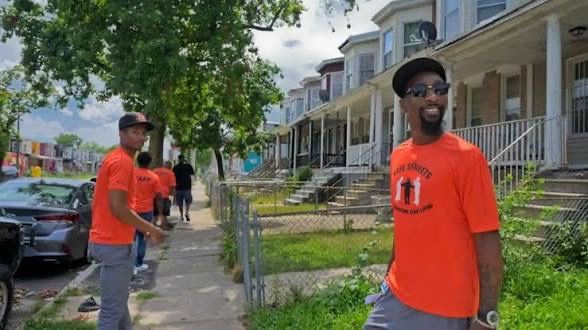
Within Baltimore, Safe Streets operates in 10 “zones,” areas historically ravaged by shootings and homicides — roughly 3% of the city’s footprint. Rather than police officers, the people doing the work are “credible messengers”: outreach workers and violence interrupters, often individuals with deep ties to the neighborhoods they serve. Many are former gang members or people with lived experience of street violence — whose familiarity with the dynamics of their communities allows them to mediate conflicts before guns are drawn.
What does this work look like in practice? According to MONSE, Safe Streets crew actively “put themselves in front of a firearm to de-escalate situations and mediate conflict.” In 2024 alone, the program reported 1,283 mediations across its sites. In some zones, the results have been striking. A 2023 study by researchers at the Johns Hopkins Bloomberg School of Public Health found that Safe Streets was associated with statistically significant reductions in homicides and nonfatal shootings in many — though not all — of its service areas.
As recently as mid-2024, three of the Safe Streets zones boasted full years without a homicide — a milestone deeply meaningful in neighborhoods long defined by loss. City Hall and supporters of community-based intervention lauded this as proof that violence interrupters and social-service outreach could save lives — perhaps more sustainably than aggressive policing alone.
But therein lies the tension that Bates has laid bare: when the actors entrusted with de-escalation, mediation, and violence interruption operate outside traditional law-enforcement accountability, how can prosecutors — whose job is to uphold justice for victims and the community — trust the process?
Bates’s letter claims that MONSE refuses to reveal the identities of these “violence interrupters,” refuses to share who is being hired, how funds are spent, and how decisions are made about who gets diverted or mediated. “The veil of secrecy that surrounds this program … continues to keep the public, my prosecutors, and the City government from truly understanding … the exact nature of the work being provided,” Bates wrote.
Moreover, Bates says, diversion programs tied to MONSE — such as another initiative, SideStep — raise serious concerns about victim and witness rights under the traditional criminal-justice system. Because SideStep relies on diversion outside formal prosecution, Bates argues his office cannot perform its statutory duties to victims and defendants.
From his vantage, the new public-health model has a fatal flaw: it hands over some portion of public safety decisions to unaccountable, opaque structures — and leaves prosecutors (and by extension, the public) in the dark.
The Stakes: Trust, Transparency, and the Cost of Secrecy
Why is this debate about “transparency” more than bureaucratic nitpicking? Because trust — once broken — can erode the fragile cooperation that undergirds modern violence-reduction strategies.
Safe Streets thrives on relationships: credibility, trust, internal knowledge, and community legitimacy. The very power of violence interrupters comes from their ability to navigate neighborhood networks, to defuse conflicts before violence — often without involving police. Their anonymity is sometimes cast as essential for their safety and effectiveness. Many are not hired directly by city government; instead, they work for community-based organizations funded by the city. That, proponents argue, can help shield them from the kind of institutional scrutiny or pressure that might compromise their outreach.
Yet those same protections — anonymity, flexible contracting — also create a zone where oversight becomes difficult. If the prosecutor’s office (the entity responsible for charging crimes, protecting victims, upholding the rule of law) cannot see who is doing the interventions, cannot trace funds, cannot know who has influence over which individuals — then a key piece of the public-safety puzzle becomes opaque to one of its principal oversight bodies.
That opacity may also undermine public trust — especially among survivors, witnesses, and community members who expect accountability. For victims of shootings or other violent crime, diversion programs can feel like bypassing justice; for neighbors, a lack of transparency can breed suspicion that certain players are above scrutiny.
By cutting formal coordination, Bates has forced the issue into the open: Should community-based violence intervention operate under the same standards of transparency and accountability as the traditional criminal-justice system? Or must it remain somewhat shadowy — insulated by the very relationships that grant it access and legitimacy in neighborhoods long distrustful of police?
The question is not academic. It goes to the heart of what kind of public safety Baltimore wants — and whether different elements can co-exist without friction.
What This Fracture Reveals About Power, Responsibility, and Public Safety
Bates’s decision comes after years of rhetorical and practical tension between his office and MONSE/the mayor’s office. According to publicly available records, Bates has long been skeptical of community-intervention programs’ impact and sees himself as the chief executor of Baltimore’s law-and-order agenda.
Under his tenure (which began in January 2023), the city recorded drops in homicide rates — including the first year since 2015 with fewer than 300 homicides. While MONSE, the mayor’s office, and Safe Streets have claimed credit for much of the downward trend, Bates has argued the credit belongs to aggressive prosecution — not diversion or community outreach.
Now, with the cut in coordination, that philosophical and operational divide becomes structural. Bates has offered to set up a special task force — composed of representatives from his office, the Baltimore Police Department, the Office of Inspector General, and the City Solicitor’s Office — to bring oversight and legal accountability to MONSE operations.
But the offer may amount to putting a square peg in a round hole. Community-based violence intervention thrives on trust, discretion, and local credibility — not on legal oversight and bureaucratic transparency. Requiring such oversight may strip away what makes Safe Streets effective in certain neighborhoods, even as it makes it more palatable to prosecutors and bureaucratic overseers.
In other words: the very structures that make Safe Streets nimble and community-driven may make it incompatible with a system that prizes legal consistency, documentation, and openness.
The Risk: Unraveling What Progress Remains
For many Baltimore residents — especially those in neighborhoods served by Safe Streets — the rupture may feel like a betrayal or a threat. The declines in shootings and homicides since 2021 are real. For some communities, every successful mediation, every intervention, every life spared felt like proof that a different model of public safety could work.
But now that model faces a major challenge. Without the support, data-sharing, and cooperation of the prosecutor’s office — a body that has unique access to victims, witnesses, crime scenes, and legal authority — Safe Streets may struggle in several ways:
Reduced credibility: If Safe Streets mediators can no longer coordinate with prosecutors, will adversaries still respect them? Will people trust them enough to intervene?
Declining referrals: Cases that might have been mediated or diverted could now go straight to arrest and prosecution. That could reverse a key benefit of violence-interruption: lowering the burden on courts and avoiding cycles of incarceration.
Loss of funding or support: With official coordination severed, political will (and public money) may shift away from violence intervention toward more traditional policing approaches.
Psychological toll: For interrupters themselves — often working in dangerous conditions, risking their lives daily — the break could feel like being abandoned by the very institutions that promised support, legitimacy, and collaboration.
If enough of these pressures build — and they may not take long — the Safe Streets program could collapse under the weight of legal, financial, and community pressure. And with it might go one of the few hopeful experiments that suggested Baltimore could reduce violence without miring more young Black and Brown men in prison.
But What Does Justice Really Demand?
Implicit in Bates’s move is a claim: justice demands transparency. Prosecutors, after all, don’t just prosecute crimes — they make decisions about which cases move forward, how to protect victims and witnesses, how to balance the rights of defendants, and how to uphold the integrity of the public trust. When parts of public-safety strategy — particularly diversion and mediation — are kept outside of that scrutiny, there is potential for abuse, favoritism, or neglect.
And in a city like Baltimore — scarred by years of violence, systemic racism, neglect, and distrust between communities and police — perhaps prosecution and community intervention were never meant to be fully integrated. Perhaps they were always two parallel systems run on uneasy coexistence.
In that light, Bates’s decision is not just a bureaucratic recalibration. It is a statement about power, accountability, and the limits of community-driven solutions. It asserts that when the work of preventing violence is handed — even partially — to non-state actors operating under informal or shielded frameworks, it undermines the principle that public safety must be public.
Yet critics will argue (and rightly so) that without community-based programs like Safe Streets, relying solely on policing and prosecution will bring Baltimore back to cycles of mass incarceration, distrust, and more violence. The danger is not just losing a program — it’s losing a vision of public safety rooted in healing, prevention, and community agency rather than punishment.
What Lies Ahead: A Fork in the Road for Baltimore
As the dust settles on this public fracture, Baltimore faces a crossroads. There are several possible paths forward — none easy, all high-stakes.
Reintegration through oversight: The task force Bates proposed could impose a framework of transparency and accountability on MONSE and Safe Streets — perhaps giving prosecutors confidence to re-engage. But doing so risks stripping violence interrupters of the discretion and street-level credibility that makes them effective.
Dual-track public safety: The city may split its approach — keep community-based interventions, but with limited or no formal coordination with prosecutors. Safe Streets could continue under a purely social-service domain (health, outreach, mediation), while serious crimes revert exclusively to police and prosecutors. That risks creating two parallel systems with little synergy.
Return to traditional enforcement: If trust does not return, the city may double down on law enforcement, prosecution, and long sentences — sacrificing community-based interventions. That risks eroding years of community trust and potentially reversing the recent gains in violence reduction.
A hybrid, transparent model: Baltimore could attempt something more ambitious — rethinking community intervention under a framework of transparency, data-sharing, and independent oversight; integrating Safe Streets (and SideStep or other diversion efforts) into a broader public-safety infrastructure that respects both accountability and community legitimacy.
Which path the city chooses could define its trajectory for years — perhaps decades.
For the People in the Streets — and the People in the Suits — the Question Remains: Who Owns Public Safety?
As I reflect on this rupture, two images linger. On one hand: the Safe Streets outreach worker, walking a block in Belvedere or Park Heights, recognized by residents, intervening in heated confrontations, listening, de-escalating, offering resources, trying to steer people away from violence. On the other: the prosecutor’s office — files, statutes, evidence, rights of victims and defendants, legal obligation, public accountability, an open letter demanding transparency.
Both pictures are vital. Both speak to something real. But rarely are they aligned.
The question now is whether Baltimore — battered, bruised, hopeful — can hold them both together. Whether the city can redesign public safety not as a top-down imposition of law, nor as a hidden patchwork of interventions, but as a transparent, integrated, accountable ecosystem.
If the current rupture deepens — if trust fractures further — the risk is not just of violence creeping back. The risk is that the very idea of a more compassionate, community-based justice may be lost.
But if Baltimore finds a way forward — one that demands transparency without sacrificing the credibility of community voices, one that respects victims and defendants while empowering residents — then perhaps this moment, painful as it is, will mark not an end — but a turning point: toward a public safety defined not by secrecy or suspicion, but by accountability, community, and dignity.


Comments